
Most payment programs do not fail from a missing vendor. Card issuers exist. Processors exist. In fact, bank sponsors and money-movement vendors exist in abundance. Programs fail because those pieces get assembled after the fact. Nobody designs them to work as one financial product.
That is the real problem. Not a missing capability. A missing architecture. Modern payment programs need infrastructure that connects accounts, cards, payment networks, and reconciliation in one system. The right architecture solves this. Adding another vendor, however, does not.
The Problem: Point Solutions Create Gaps, Not Just Vendors
Disconnected components can make a payment program look complete on a slide, and still let it break in production. Data lives in different systems. As a result, reconciliation runs on different schedules. Risk controls sit in different places, disconnected from the ledger they should inform. Every new capability the business wants to add means another integration, another vendor relationship, another seam where something can fail.
In practice, this shows up the same way for banks and for B2B platforms, just with different entry points.
Commercial Banks: Fragmentation by Design
For commercial banks, the standard approach has been fragmented by design. A virtual account management product from one vendor, card issuing through a legacy processor that has held the relationship for thirty years out of inertia, payment rail coverage assembled across ACH, wire, RTP, and FedNow through separate integrations.
Even so, each capability works on its own. None of them share a ledger. Reconciliation happens manually, at month-end, by a team that grows in headcount every time transaction volume grows. Even capabilities that should function as part of an integrated receivables platform can end up operating as separate products with separate data and reconciliation processes.
Commercial clients experience the gaps directly. They get batch reporting instead of real-time positions. They cannot configure their own account structures without calling the bank. Eventually they compare that experience to what a fintech treasury platform offers, and the comparison is not close.
B2B Platforms: The Same Gaps, Different Architecture
For B2B platforms, the standard build path looks similar. Card issuing comes from one provider. ACH origination and wire transfer capabilities come from a bank partner’s API. RTP payment rails and FedNow arrive later. A custom-built ledger layer an engineer assembled because nothing else reconciled cleanly. Compliance sources a fraud tool independently.
Similarly, each piece works on its own. The gaps between the pieces do not. Funds sit in pooled accounts with no real-time segmentation by program or cardholder. When something breaks, it breaks at the boundary between systems. This is exactly where nobody has clear ownership.
When Infrastructure Gaps Become Regulatory Risk
The BaaS middleware collapse of 2024 was not, in fact, a fraud story. It was an infrastructure story. Platforms that moved money without a real ledger underneath ran into commingling risk and reconciliation collapse the moment their banking partners looked closely. The regulatory response since has been direct: demonstrate fund segmentation, demonstrate reconciliation capability, demonstrate that you know where every dollar is at every moment. A platform built on point solutions can answer those questions. But it takes time, it takes people, and teams assemble the answers after the fact from multiple systems.
For commercial banks specifically, this is also a client retention problem. Banks are losing their best clients slowly and quietly, not to other banks, but to companies that did not exist ten years ago. Those companies are not winning on relationships. They are winning on real-time cash visibility, flexible account structures, and card programs that work the way a commercial finance team actually operates. The CFO across the table has already looked at the alternatives.
The Promise: One Connected System, Not Four Vendors Stapled Together
Qolo unifies virtual account management, card issuing and processing, and multi-rail payment orchestration on a single cloud-native platform. One API. No fragmented vendor stack to stitch together. No ripping out infrastructure that already works.
Qolo is the first modern processor to win a top-20 commercial card relationship with a major U.S. bank. That door had been closed to every modern infrastructure player for thirty years. It opened because the architecture was built the other direction from most of the market: bank-grade requirements from day one, wrapped in a clean API, rather than consumer fintech infrastructure retrofitted toward bank-grade later. That distinction is what makes Qolo a credible option for institutions at this tier.
Three things Qolo is not, because they define the promise as much as any positive claim does:
First, Qolo is not a rip-and-replace. Banks do not migrate their core to work with Qolo. The platform is a layer on top of the existing core, maps to DDAs, and makes the core capable of things it was never built to do. Deployment timelines for new commercial programs are measured in weeks, not years.
Likewise, Qolo is not middleware. It does not abstract away the bank or the platform and add fragility in exchange for speed. It is infrastructure that enhances what the client already owns, not an intermediary sitting between them and their funds.
Finally, Qolo is not just a card issuer stretched to cover everything else. Card issuing is often the right place to start, especially for B2B platforms. It is not the ceiling. A card program is only as reliable as the ledger underneath it.
The Product: How the Stack Actually Connects
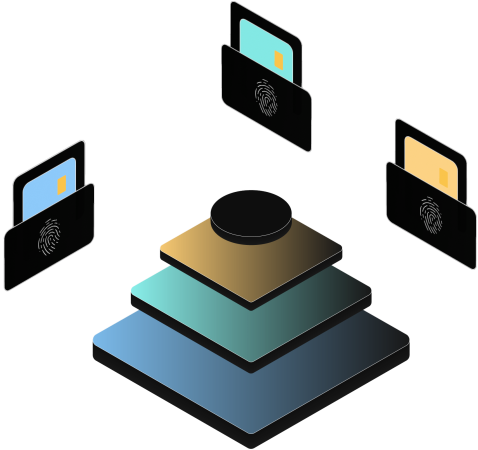
Qolo’s platform starts with Quantum Ledger and builds every capability on top of it, not alongside it. Every card transaction, every rail payment, every virtual account movement, and every authorization decision posts to the same ledger in real time. The ledger is not a reconciliation tool run at month-end. It is the live operating system every other capability runs on.
Quantum Ledger and Virtual Account Management (VAM)
Quantum Ledger and Virtual Account Management (VAM) form the foundation. Quantum Ledger is a real-time, double-entry, programmable ledger that maps to existing DDAs. It creates virtual account hierarchies of any depth: program-level, cardholder-level, client-level, multi-entity. These are operational accounts with unique routable identifiers, not reporting overlays or view-only tags.
Quantum Ledger builds fund segmentation into its structure instead of relying on operational management. Commingling isn’t a risk to monitor. It’s a condition the architecture prevents.
Qinetic Issuing
Qinetic Issuing is the commercial card issuing and processing stack: physical and virtual cards across credit, debit, and prepaid constructs, multi-network across Visa, Mastercard, and Discover, purchase cards, single-use virtual cards for AP workflows, and declining-balance constructs for specific programs.
Because every construct runs on Quantum Ledger, card program reconciliation is not a separate process. It is the same reconciliation as everything else on the platform. Authorization controls are configured per card, per program, or per hierarchy level via API in real time, no processor tickets, no release windows.
Banks that need to stay in the authorization decision loop can use the Sparq engine. Sparq supports cooperative authorization flows, calling the bank’s own decisioning system in real time as part of the approval.
Qascade Money
Qascade Money is Qolo’s multi-rail payment orchestration engine. It connects payment flows across the platform and supports ACH push and pull, including same-day ACHwire transfers, RTP, FedNow, and push-to-card through a single API. Every payment posts to Quantum Ledger in real time, enabling unified visibility and reconciliation across rails.
Every payment that Qascade Money processes routes according to configurable rules for cost, speed, and corridor. As a result, rail coverage stops being a multi-vendor management problem. It becomes a configuration decision.
Qolo Shield
Qolo Shield applies fraud and risk controls at authorization time. It covers merchant and MCC controls, velocity limits, CVV failure thresholds, geographic distance checks, and network fraud score integration. A platform’s own ops or risk team configures these rules directly in the Optiq Portal, with no engineering ticket queue involved.
Shield sits inside the authorization flow and posts to Quantum Ledger. Consequently, fraud controls share the same system as funding and reconciliation. There is no separate data model and no reconciliation gap between fraud events and ledger positions.
The Proof: What This Looks Like in Practice
Top-20 U.S. banks have deployed Qolo. None of them replaced their core to do it. That is the practical test of the no rip-and-replace claim. It is not a sales objection handler. It is what actually happened at institutions with the most to lose from getting infrastructure decisions wrong.
Qolo now operates as part of CSI. That adds institutional backing to a platform that already meets bank-grade standards from day one. Banks evaluating a modern infrastructure partner get two things: proven deployments at scale and the stability of an established parent company. So, together, they answer the two questions that come up in nearly every vendor risk review. Can this company deliver? Will it still be here in five years?
In short, the proof point that matters most is a simple test. Ask the provider to trace one transaction from initiation through authorization, ledger posting, routing, settlement, reporting, and exception handling. If that explanation requires pulling answers from several disconnected systems, the platform integrates commercially without achieving real architectural unity.
A point-solution platform can eventually produce those answers. A single-ledger platform produces them in real time, at any moment. There is only one source of truth to check.
What This Means for How You Evaluate a Payments Partner
A few questions cut through vendor positioning faster than a feature checklist:
- Is there a real-time ledger at the center of the platform, or does a reporting layer sit on top of separate systems instead?
- Do card transactions, rail payments, and account movements post to the same financial record, or do they live in different systems that a team reconciles later?
- Does the provider require a rip-and-replace of the core, or does it enhance what already exists?
- Can the organization demonstrate, in real time, where funds are and how the ledger segments them, or does that answer take a week and three spreadsheets?
Ultimately, banks and platforms don’t need another vendor. They need fewer financial truths to reconcile and more confidence in the one that exists.
Qolo was built to be that layer. One ledger. API-first. Sitting on top of what already works, and making it capable of what comes next.