
Commercial banking payments infrastructure is under serious pressure right now. Banks are facing constant demands to support real-time transactions, card-based disbursements, ACH, wires and virtual accounts. Corporate clients want faster settlements, automated reconciliation and embedded finance capabilities that actually work.
The problem is that most bank payments infrastructure was never designed to handle this level of complexity.
Instead of forcing new products onto legacy rails, forward-thinking banks are realizing they need a completely different approach. They do not need another point solution. They need an orchestration platform. Selecting the right payment platform is crucial for improving business operations, as it enables features like electronic payments, reconciliation, and direct data access that improve both customer experience and operational efficiency.
Scalability is essential for handling peak transaction volumes without downtime. Additionally, ease of integration through well-documented APIs allows the platform to connect quickly to existing systems, ensuring a smooth transition and rapid deployment.
The payments landscape has fundamentally changed
Over the past few years, the U.S. payments ecosystem has expanded at an incredible pace. The Federal Reserve launched FedNow in July 2023 as a new instant payments rail with an initial per-transaction limit of $500,000. Adoption was rapid. To meet growing commercial demand, the FedNow network transaction limit increased to $10 million in November 2025. The modern payment processing network enables real-time, electronic transfer of funds between banks and financial institutions, supporting instant transactions and broad connectivity.
Meanwhile, The Clearing House’s RTP network continues to break records. The network processed over 107 million transactions in Q4 of 2025 and supports over 1,000 participating financial institutions. Digital payments are processed quickly and securely through these networks, enabling instant transfers and reducing settlement times.
Corporate customers see these advancements and expect their banks to keep up. They want real-time visibility into their cash positions and payment activity. They are pushing commercial banks for faster disbursements, virtual account structures, seamless supplier payments and integrated treasury reporting. Real time payments and digital payment methods are becoming essential for meeting demands for speed and flexibility.
Meeting these expectations requires a lot more than just plugging in another payment rail. Payment rails work by facilitating the transfer of funds between financial institutions, and choosing among different payment rails affects transaction speed, cost, and security.
Payment rails also enable you to accept alternative payment methods, including checks, credit and debit cards, and even certain forms of cryptocurrency. Transaction costs can vary significantly across these payment rails. The right strategy blends different payment rails intelligently to balance cost, speed, and reach.
The limits of legacy bank payments infrastructure versus a multi rail payments strategy
Most banks built their internal systems in layers over several decades. The typical setup looks like a sprawling maze. You have one system for ACH – where ACH transactions are bank-to-bank payments facilitated via the Automated Clearing House network, moving money from one bank account to another and often described as digitized checks. You have another for wires. And a totally separate card issuing platform and a handful of third-party vendor integrations trying to hold it all together. ACH is the underlying technology for direct deposits, bill pay, and many auto-pay and peer-to-peer payments. The ACH network processed $35.2 billion in 2025, making it one of the most popular payment rails for online payments.
This fragmented architecture creates massive operational friction. Payment routing decisions are either inflexible or entirely manual. Recurring payments and direct deposits are often managed through ACH, but legacy systems make it difficult to automate these processes efficiently. Finance teams waste hours stitching data together to close the books or answer audit requests. Launching a single new product requires fragile integrations that drain developer resources. The originating depository financial institution plays a critical role in initiating and validating ACH transactions, including verifying sufficient funds before processing. Worst of all, client visibility into balances and transactions is often delayed. Accurate payment instructions and transaction details are essential for secure and efficient processing across different payment rails, but legacy systems often make this challenging.
When banks introduce new rails to this environment, the new tech usually sits next to the existing infrastructure rather than integrating with it. The result is a growing collection of payment channels without a unified operating model. Managing payments from one bank account to another across different systems becomes increasingly complex. You cannot duct-tape five different vendors together and expect a reliable, scalable system.
Why orchestration is the new standard for how payment rails work
Leading institutions are starting to rethink commercial banking modernization. They are moving away from siloed channels and building around orchestration instead.
What a payments orchestration platform does
A proper payments orchestration platform gives banks a centralized hub. From one single place, you can route multi-rail payments, apply risk controls, manage account hierarchies and provide real-time transaction visibility. A payments orchestration platform connects a business to multiple payment gateways, payment processors, and alternative payment methods through a single integration, significantly reducing IT overhead.
Instead of building a separate product for every single rail, banks can design client-centric experiences that operate across all rails simultaneously. Payment rails dictate which currencies can be supported, how quickly settlements occur, and which partners or networks a business can connect to, making a multi rail strategy essential for flexibility and resilience.
How intelligent routing improves payment reliability
Consider how a commercial client initiates a payment request. An orchestration layer can automatically determine the best path. Should the payment go via RTP, FedNow, ACH or card? Does it meet the necessary compliance thresholds? Which specific account hierarchy should fund the transaction? How should the system reconcile the data? Intelligent routing and dynamic routing allow the platform to automatically direct payments to the processor most likely to approve them based on real-time data, optimizing for cost and success. If the primary processor is down or a payment is declined, failover routing enables transactions to be rerouted to a backup provider, ensuring reliability.
The role of security, analytics, and cost optimization
In this model, the payment rail simply acts as a delivery mechanism. The real value lives in the intelligent routing and control layer sitting above it. Strong security features like tokenization and encryption are essential, and tokenization can help reduce PCI DSS compliance scope. The platform should provide a centralized view of payment health through unified analytics, and offer built-in fraud detection tools to block suspicious activity. Third party service providers play a key role in enabling access to real-time payment processing, digital wallets, and innovative payment solutions for financial institutions. By routing to the most cost-effective processor, companies can lower transaction fees and reduce processing costs across rails. The platform increases approval rates, reduces technical debt, and manages complex global payment methods.
The shift toward programmable infrastructure
Modern payments for banks increasingly rely on programmable infrastructure. This approach gives financial institutions the ability to configure account hierarchies, track balances in real time, automate sweep logic and establish dynamic rules for every transaction. Programmable infrastructure also supports efficient funds transfer and financial transactions across multiple payment rails, keeping the movement of money secure and traceable.
These tools allow banks to support highly complex client use cases. Corporate customers can automate supplier payments, concentrate treasury cash, disburse insurance claims and build embedded banking platforms with ease. Supporting digital payment methods and online transactions is essential to enhance customer experience and business efficiency. Granular fund segmentation lets businesses organize funds into specific sub-accounts for precise control over client funds and operational expenses.
The best part is that banks can deploy these advanced capabilities without ripping out their existing core banking systems. You can leverage your core banking platform while extending its capabilities through a scalable, API-first architecture.
For instance, platforms with embedded, bank-grade ledgering allow you to track every transaction and client fund with absolute precision. This creates a single source of truth that segments and traces every dollar coming in and going out. Banks can offer corporate clients the exact treasury tools they need to optimize cash flow and reduce manual reconciliation errors. Multi-rail strategies can further enhance customer experience by providing more choices for payment methods.
What the future bank payments stack looks like
The next generation of bank payments infrastructure relies on a few critical components working together in perfect harmony.
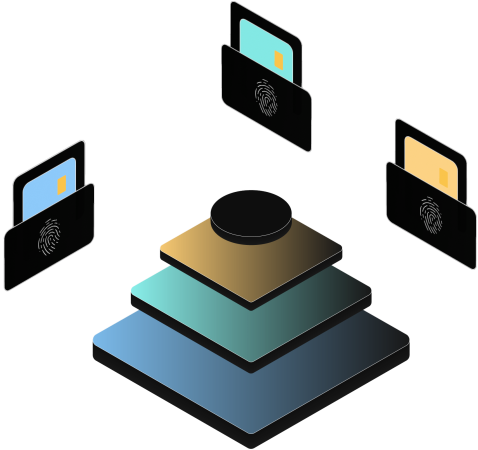
You still have your core banking system securely managing the foundational accounts. Layered above it, you find an orchestration platform handling the complex logic and multi-rail connectivity. You also need a programmable ledger to manage the underlying fund segmentation and client-facing APIs to deliver clean, automated reporting.
When these pieces work as one system, banks can build and launch new payment products faster than ever before. The importance of real time payment systems and major payment rails lies in their ability to enable instant, 24/7 electronic transfers.
Adopting a multi-rail strategy brings resilience, cost efficiency, flexibility, redundancy, and an enhanced customer experience by providing more payment options and dynamic routing. Dynamic routing uses algorithms to optimize a payment’s path for speed and cost, allowing businesses to complete more payments and process them faster.
They eliminate manual workarounds and replace them with intelligent automation.
The bottom line
Winning in the commercial banking space requires more than just offering the highest number of payment rails. It requires delivering absolute control, flexibility and visibility across all of those rails.
This is treasury management modernization in practice, not a slide about digital transformation. It shows up as fewer manual reconciliations, fewer emergency calls about a missed sweep, and a treasury team that can answer a commercial client’s cash position question in the same meeting instead of the next day.
The future of payments is not strictly defined by ACH, RTP, FedNow or cards. It is defined by how intelligently banks orchestrate them. Ready to start your orchestration journey? We’re here to help.