
Money now moves in seconds. Yet most payment programs still find out where it went the next morning.
Most card programs do not fail at launch. Instead, they become harder to operate as they grow.
Balances sit in one system, while transactions sit in another. Finance teams reconcile them using reports, spreadsheets, and manual allocation. Every new customer segment, funding source, card construct, or payment rail adds another exception.
Over time, the product becomes limited not by demand, but by the financial infrastructure underneath it.
As instant payments scale, this overnight gap becomes more than an operations problem. It becomes a risk problem.
An embedded ledger platform addresses this issue at the architectural level. It establishes the account structures, balance logic, financial events, and relationships a product needs before the first card is issued.
Cards, payments, account hierarchies, and reporting then operate from the same financial foundation. Instead of producing separate versions of the truth, they share a consistent view of financial activity.
This is the difference between adding ledgering after a program has grown and designing the program around a ledger from the start. That distinction matters to B2B platforms building financial products. It also matters to commercial banks modernizing card and account offerings without replacing their cores.
The Problem: Why Card Programs Without Ledger Infrastructure Struggle to Scale
Consider a B2B platform launching a commercial card program. Initially, the model may be straightforward. There is one funding account, one processor, one customer segment, and one daily report that matches the two.
Then the program works.
Customers add employees and contractors. A second segment uses prefunded balances instead of the original funding model. The platform adds vendor payments over ACH. Finance needs balances by customer, program, cardholder, and funding source. Product wants new card constructs. Operations needs to explain why an authorization, settlement, and customer balance do not appear at the same time.
The same pattern plays out in AP automation, payroll, expense management, and disbursement platforms. Each request exposes the same underlying issue. The processor knows what happened on the card network. The bank account shows an aggregate balance. However, the relationship between the two lives in a separate data model, a reconciliation process, or the knowledge of the people who maintain it.
The Operational Cost of Disconnected Financial Systems
The consequences compound:
- Balance and transaction views arrive late or disagree across systems.
- Reconciliation spans more systems and more financial entities.
- Program and cardholder attribution depends on manual allocation.
- New products require new operational workflows.
- Exceptions become harder to isolate as volume and account structures grow.
- A migration becomes more difficult once live balances and historical activity are spread across disconnected systems.
These are infrastructure problems. Adding analysts may increase the capacity of a manual process, but it does not fix the architecture that created the problem.
As a result, teams must continue reconstructing the financial picture from systems that were not designed to share one model of balances, movements, and ownership.
What Synapse Taught the Industry
The 2024 collapse of BaaS middleware provider Synapse made this failure mode impossible to ignore.
Partner banks reported holding roughly $219 million in end-user funds, yet reconciliation surfaced a shortfall of $65 million to $95 million against what the ledger said should be there (Chapter 11 trustee filing).
A lawsuit later argued that the partner banks’ lack of direct access to Synapse’s ledger contributed to the outcome. It also pointed to their failure to maintain their own copy of the ledger (Banking Dive).
The lesson for every payment provider: if your view of where money sits depends on someone else’s records, you do not have a view. Read our BaaS collapse post for the broader context.
Regulators Have Raised the Bar
In July 2024, the Federal Reserve, FDIC and OCC issued a joint statement warning that fragmenting deposit operations across several third parties makes it harder for a bank to assess its risk (OCC Bulletin 2024-20). The FDIC followed with a proposal requiring banks that hold custodial accounts to keep end-user records and reconcile at the close of each business day (FDIC). That rule has not been finalized, but the supervisory expectation is clear: know who owns every dollar, every day.
The lesson reaches beyond any one market event. Financial structure has to be designed into the product before growth makes it difficult to change.
Why Real-Time Rails Have Raised the Stakes
For most of the last two decades, batch reconciliation was tolerable because money moved in batches. That assumption no longer holds.
- Instant rails are now mainstream infrastructure. More than 1,800 financial institutions are live on FedNow (Federal Reserve Financial Services) and the service settled 8.4 million payments worth $853.4 billion in 2025, roughly 459% more volume than the year before. (ClearingPost)
- B2B is going digital first. Checks were used for 81% of B2B payments in 2004. In the 2025 AFP Digital Payments Survey, that figure fell to a record low of 26%. (Nacha)
When a payment settles in seconds on a Saturday, its attribution cannot wait for Monday’s batch. A program has to know the available balance, the owner of the funds and the program it belongs to at the moment of authorization or release. A ledger built for overnight matching cannot answer that question. A ledger embedded in the product can.
What an Embedded Ledger Is and Is Not
An embedded ledger platform is the operating system for the money a financial product holds and moves. It records financial events, maintains the balances those events produce, and defines how accounts, programs, cardholders, and payment activity relate to one another.
The word embedded matters. The ledger is part of the product architecture, not a report or database attached after transactions occur. Account hierarchies and balance logic are defined first. Cards and payment flows are then issued and managed against that structure.
An embedded ledger is also different from an accounting sub-ledger. An accounting sub-ledger helps explain activity for financial close. An embedded ledger helps operate the financial product itself: it applies balance logic, tracks movements, supports account relationships, and gives the product a consistent position as money moves.
How an Embedded Ledger Differs From Processing and Reporting Tools
It is useful to separate the ledger from the capabilities around it:
- A payment processor facilitates transactions, including authorization, clearing, and network messaging. It is not necessarily the financial record of the relationships behind every transaction.
- Virtual Account Management creates account hierarchies and sub-accounts. Those structures require a ledger underneath them to provide balances, movements, and history.
- Reporting tools present information from one or more systems. They can help identify a discrepancy, but they cannot create the underlying financial structure.
- Reconciliation tools compare records. They cannot replace the system that records and connects those records in the first place.
These capabilities work best when they share one foundation. An embedded ledger is not a dashboard, reporting feature, reconciliation utility, or database bolted onto a processor. If it can be removed without changing how the financial product works, it is not the ledger at the center of the product.
What Ledger-First Architecture Delivers: Fund Segregation, Real-Time Visibility, and Reconciliation at Every Level
Designing the ledger into the product changes how financial operations work in four important ways.
Fund segmentation at the program level
B2B platforms often serve multiple customers, programs, business units, and funding models. Each needs balances and activity that can be identified without manual allocation.
At the ledger level, that means funding events, card transactions, fees, and other supported movements are recorded against a defined program structure. The question of what belongs to which program is answered by the system rather than reconstructed from separate reports.
This is ledger-level fund segmentation. It creates a precise record of attribution and supports clearer financial control. It does not, by itself, determine the legal ownership, custody, trust status, or bankruptcy treatment of funds. Those questions depend on account structures, agreements, and banking relationships.
Fund segregation at the cardholder and end-user level
Program-level structure is not enough for many commercial products. Operations needs to see an individual cardholder’s balance. A customer may want to set a limit for one employee. Finance may need to attribute a fee or transaction to the person who generated it.
That structure should exist before cards are issued. Retrofitting it later can require remapping live balances and historical activity onto a hierarchy that did not exist when those events occurred. Establishing the relationship at the beginning gives the product a stable structure as cardholders, customers, and programs expand.
Real-time financial visibility
A unified ledger gives product, operations, and customers a consistent view of balances and activity. Every supported debit and credit can post to the same financial structure, with visibility at the master, program, and cardholder levels.
That visibility can inform authorization, customer experience, support workflows, funding decisions, and reporting. It also makes the difference between a recorded ledger event and movement on an underlying payment rail explicit. A ledger entry can reflect a financial event as it posts, while settlement follows the timing and rules of the rail. Sound architecture keeps those concepts connected without treating them as identical.
Continuous reconciliation
When transactions, accounts, programs, and cardholders are connected through structured records, reconciliation becomes a comparison between linked records rather than a forensic exercise across unlinked systems.
Quantum Ledger supports real-time posting and continuous reconciliation for supported card and payment movements. External statements, settlement timing, and exceptions may still require review. The change is where the work happens: teams spend less time reconstructing relationships and more time reviewing genuine exceptions.
The principle across all four capabilities is the same. Financial control is designed into the product instead of reconstructed from disconnected data after the fact.
How Quantum Ledger Works: The Infrastructure Layer Underneath Card Programs, VAM, and Payment Rails
Quantum Ledger is Qolo’s real-time, programmable ledger. It is the foundation of Qolo’s payments architecture, connecting balances, transactions, and account structures across programs, entities, and supported payment flows.
It is not a module attached to a card processor. Qolo’s card programs, Virtual Account Management, and payment orchestration operate against the same ledger foundation.
Card issuing and processing runs against that structure. Qinetic Issuing creates and manages physical and virtual card programs with the controls and constructs required by commercial and embedded use cases. Card activity posts to the same financial structure as the rest of the program’s supported movements.
Virtual Account Management provides the hierarchy. It organizes master accounts, programs, customers, and sub-accounts so that balances and activity can be viewed at the level the product requires. Fund segmentation is established at the program and cardholder levels before a card is issued, rather than added later through manual allocation.
Payment rails use the same foundation. Qascade Money orchestrates supported payment flows, including ACH, RTP, and wire. Those movements post to the same ledger as card activity, allowing the program to view and reconcile supported card and payment activity in one connected structure.
One Ledger Connecting Cards, Virtual Accounts, and Payments
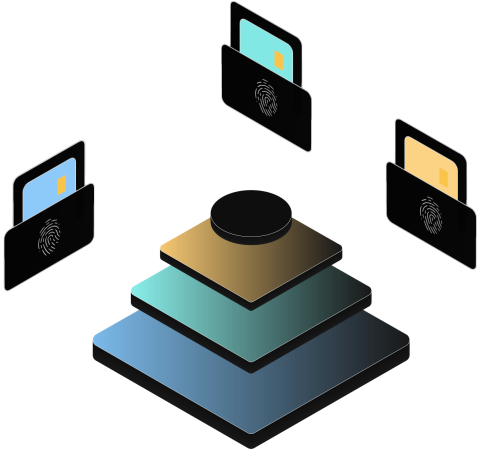
The result is not four separate products with a reconciliation layer added between them. It is one connected architecture with the ledger at its center. That architecture gives product teams a stronger base for new financial products, gives operations a clearer view of balances and movements, and reduces the structural limits that appear when every new capability requires another system.
Quantum Ledger also works alongside a bank’s existing core. It adds payment-product ledgering, virtual account structures, and related account logic without requiring the bank to replace its core system of record or migrate its deposit base.
Why This Matters for Fintechs and B2B Platforms Specifically
Launching a card program and building a financial product that scales are different projects. The first is a go-live milestone. The second is an architecture decision made before it.
A platform issuing cards to employees of its business customers may need balances at the customer, program, and employee level. A platform adding vendor payments alongside cards may need one view across card and rail activity. A disbursements platform adding a new customer segment may need to extend its existing structure rather than rebuild the financial model each time.
How Ledger Architecture Affects Product Strategy and Scale
The specific use case varies, but the underlying requirement is consistent: the financial structure has to grow with the product.
For a CPO, the ledger influences which products and funding models can be added to the existing platform. It also helps determine which additions would require a redesign.
For a CTO, the ledger determines whether balances, account hierarchies, authorization events, payment movements, and reporting share a coherent data model.
For a Head of Payments, it affects the operational effort required to explain, allocate, and reconcile activity across programs and rails.
That is why the ledger belongs in the product strategy conversation. It is not only a finance-system decision. It shapes the product surface, the API model, the operating model, and the cost of expansion.
Timing matters. Ledger decisions are easiest to make before balances are live and transaction history is growing. Before launch, the decision is primarily architectural. After launch, changing the structure may require a migration.
Why This Matters for Banks
Commercial banks face the same infrastructure question from a different position. Their commercial clients increasingly expect real-time cash visibility, flexible account structures, modern card programs, and payment experiences that fit into their existing financial workflows.
A bank’s core is designed to perform foundational functions such as account servicing and deposit accounting. It may not be designed to create granular virtual account hierarchies for every commercial client, run complex card programs, and connect activity across multiple payment flows in one operating model.
Qolo works alongside the bank’s existing core rather than requiring a rip-and-replace program. Quantum Ledger and Virtual Account Management add the ledgering, hierarchy, and payment-product capabilities needed to support modern commercial offerings while the bank retains its existing core environment.
The model also matters commercially. Qolo is payments infrastructure and processing, not a BaaS provider standing between a bank and its customer. The bank can deliver the resulting product through its own commercial and treasury experience, with Qolo providing the infrastructure underneath it.
For a bank, the value is architectural readiness: the ability to support complex commercial programs, account structures, card products, payment flows, and operational requirements on a foundation built for those relationships.
Proof: Infrastructure Deployed at Major U.S. Banks
Qolo is the first modern payments infrastructure company to power commercial virtual card issuing directly for a top-25 U.S. bank, integrated into the bank’s core and treasury platform and delivered as the bank’s own product.
That relationship demonstrates that modern payments infrastructure can meet the requirements of a major commercial banking environment. The same architecture is available to B2B platforms building financial products outside the bank.
Both bank clients made strategic investments in Qolo after deployment. That is not a substitute for a technical benchmark, but it is evidence that the infrastructure became part of a broader strategic relationship after operating in a major bank environment.
Build on the Right Foundation
The ledger architecture you choose today shapes the financial products, card programs, and payment experiences you can support tomorrow.
Whether you are a B2B platform or fintech planning a card program, or a commercial bank modernizing its card and account offerings, Qolo can help you evaluate the infrastructure underneath the product.
Talk with the Qolo team about your program requirements, ledger architecture, card issuing, Virtual Account Management, payment orchestration, and reconciliation model.